Hussein Mussa Muafa
Medical Doctor · General Practitioner · Clinical Researcher
Research interests include cardiothoracic surgery, evidence synthesis, robotic surgery and medical innovation.
Medical Insights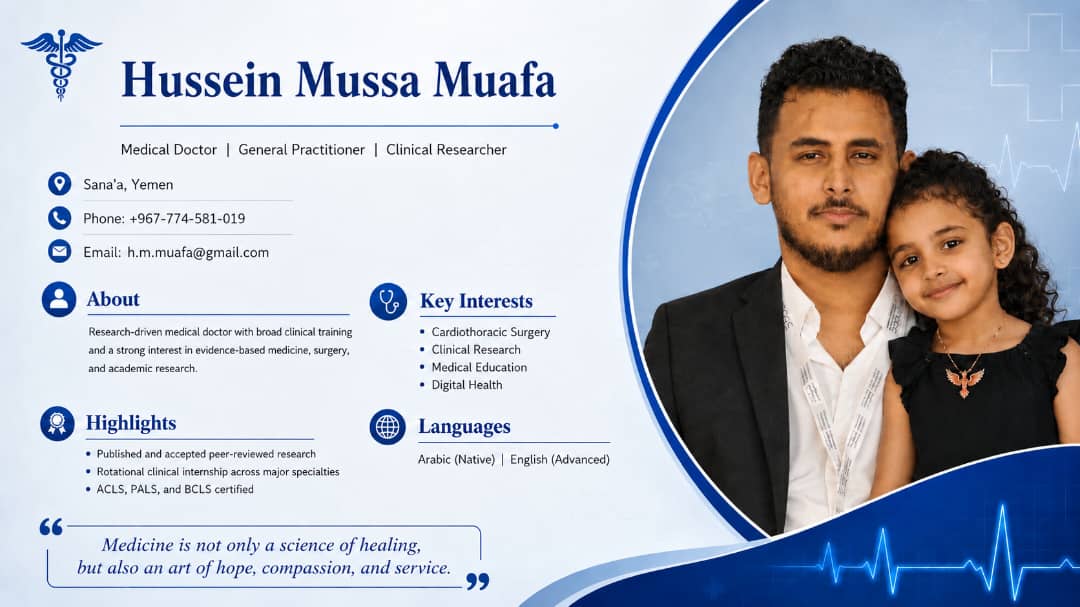

Medical Doctor · General Practitioner · Clinical Researcher
Research interests include cardiothoracic surgery, evidence synthesis, robotic surgery and medical innovation.
Research & Projects
Robotic-assisted versus laparoscopic surgery for colorectal resection in oncologic surgery: a systematic review and meta-analysis of randomized controlled trials
Abstract
Background
Robotic-assisted surgery (RAS) is increasingly used for colorectal cancer (CRC), but its clinical and oncologic advantages over conventional laparoscopy (LS) remain uncertain. Prior meta-analyses (e.g., Huang et al., Front Oncol 13;1273378, 2023; Zou et al., BMC Surg 25;86, 2025) have included overlapping RCTs but vary in methodology, scope, and analytical transparency. This review aims to provide an updated, independently re-analyzed synthesis of RCTs published from 2015 to 2025, with full PRISMA compliance, explicit analytic reproducibility, and expanded evaluation of bias and evidence certainty.
Methods
A systematic review and meta-analysis was conducted according to PRISMA guidelines. The protocol was retrospectively registered in PROSPERO (Registration ID: CRD420251237158). PubMed, Embase, and Cochrane CENTRAL were searched (January 1, 2015–January 31, 2025). Full reproducible search strings, PICOS criteria, and inclusion/exclusion rules were predefined. Only RCTs comparing RAS vs. LS for malignant colorectal disease were included. Data extraction was performed independently by two reviewers. Meta-analyses used DerSimonian–Laird random-effects models; standardized procedures were applied for converting medians/IQRs into means/SDs and for continuity corrections in zero-event trials. Risk of bias was assessed using Cochrane RoB 2.0, and evidence certainty was graded using GRADE.
Results
A total of 12 RCTs encompassing 3,107 patients met the inclusion criteria. RAS resulted in significantly lower conversion-to-open rates (OR 0.42; 95% CI 0.28–0.63; I²=18%) compared with LS. Operative time was consistently longer with RAS (MD + 23.8 min; 95% CI 14.2–33.4; I²=67%). Overall postoperative complications (Clavien–Dindo ≥ II) were comparable (OR 0.91; 95% CI 0.76–1.13; I²=22%). Length of stay showed a small but significant reduction with RAS (MD − 0.8 days; 95% CI − 1.3 to − 0.2; I²=49%).
Pathologic outcomes showed lower circumferential resection margin (CRM) positivity with RAS (OR 0.59; 95% CI 0.41–0.85). Lymph node retrieval was slightly higher with RAS (MD + 0.71 nodes; 95% CI 0.25–1.18). Distal margins and TME completeness were equivalent. No RCT reported mature long-term oncologic outcomes; evidence remains limited to short-term surrogates.
Conclusions
In contemporary RCTs, RAS provides fewer conversions and slightly better pathologic surrogates, while maintaining similar morbidity compared to LS. The main trade-off remains longer operative time and higher resource use. True oncologic equivalence cannot be confirmed until long-term RCT data mature. Advanced imaging (e.g., SOMATOM Force CT), age-specific MIS evidence, and the emergence of endoluminal robotic systems are likely to shape future refinements in technique and patient selection.
Selected Publications
Robotic-assisted versus laparoscopic surgery for colorectal resection in oncologic surgery: a systematic review and meta-analysis of randomized controlled trials
ViewEvolution of coronary artery bypass grafting: conventional, minimally invasive, robotic, and hybrid revascularisation techniques
ViewLatest Medical Insights
فشل القلب
نظرة عامة
يحدث فشل القلب عندما لا تضخ عضلة القلب الدم كما ينبغي. وعند حدوث ذلك، غالبًا يرتد الدم، ويمكن أن تتراكم السوائل في الرئتين، مما يُسبب الإصابة بضيق النفس.
تسبب بعض الحالات المرَضية في القلب إضعاف القلب أو تيبسه ببطء بدرجة تؤثر في قدرته على سحب الدم وضخه بشكل مناسب. وتتضمن هذه الحالات المرَضية ضيق شرايين القلب وارتفاع ضغط الدم.
قد يحسّن العلاج المناسب أعراض فشل القلب وقد يساعد على إطالة عمر القلب لدى بعض الأشخاص. ويمكن أن تحسن التغييرات في نمط الحياة جودةَ الحياة. حاول فقدان الوزن وممارسة التمارين الرياضية وتقليل تناول الملح والسيطرة على التوتر.
لكن فشل القلب قد يكون مهددًا للحياة. وقد تظهر على الأشخاص المصابين بفشل القلب أعراض خطرة. وقد يحتاج بعض الأشخاص إلى إجراء عملية زرع قلب أو تركيب جهاز لمساعدة القلب على ضخ الدم.
ويمكن تسمية فشل القلب بفشل القلب الاحتقاني.
Robotic Cardiac Surgery in 2026: Where Are We Now?
A concise overview of robotic cardiac surgery.
Contact
For academic, research and professional enquiries, send a message using the form.